Weekly Market Update: 07 January 2026

Crypto Starts 2026 Strong as Cycle Assumptions Are Tested
Crypto kicked off 2026 with a strong rebound, increasing discussions around whether this cycle is beginning to break away from the traditional four-year pattern. Bitcoin finished the week up 5.75%, while Ethereum bounced 10.8%. XRP stood out among the top 10, climbing 22.8%, as momentum returned across large caps. The move was accompanied by nearly $60M in inflows into XRP ETFs, marking one of the highest trading-volume days since the products launched.
Risk appetite picked up more aggressively in higher-beta assets. VIRTUALS surged roughly 70%, while memecoins including FARTCOIN, PEPE, and BONK posted gains in the 55–60% range. The speed of the rebound reflects how quickly sidelined capital can rotate once conditions improve, particularly after a compressed and low-liquidity finish to the year. While participation remains selective, the early-year move has clearly reset market tone and reopened the conversation around how this phase of the cycle may evolve.
Revisiting the Four-Year Cycle
Bitcoin closing 2025 lower than where it began marked a notable deviation from the historical post-halving pattern that has held since 2012. For the first time, the year following a halving failed to deliver a net positive return, raising questions about how much weight the traditional four-year cycle still carries. The shift reflects how Bitcoin’s price formation is increasingly shaped by broader macro forces, including ETF flows, institutional capital allocation, central bank policy, and geopolitical dynamics, alongside, rather than purely driven by, programmed supply reductions.
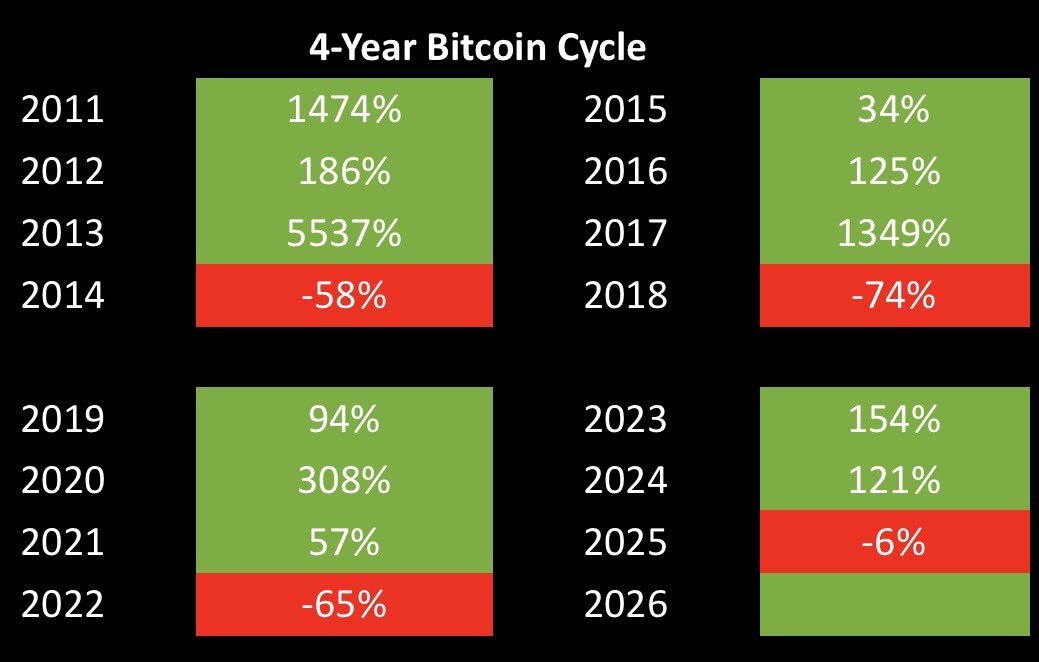
Halving still matter from a structural supply perspective, but their marginal impact appears to be diminishing as Bitcoin matures. The 2024 halving, in particular, had a limited directional effect on price compared to prior cycles, suggesting that supply-side mechanics alone no longer dominates market behaviour. As Bitcoin continues to integrate into traditional portfolios and trades more like a macro-sensitive asset, cycle-based timing frameworks may offer less predictive clarity than they once did. Going forward, liquidity conditions, policy expectations, and capital flows are likely to play a more central role in shaping price action than mechanical halving narratives alone.
Venezuela Speculation Emerges
The capture of Nicolás Maduro through Operation Absolute Resolve on January 3, 2026, serves two primary purposes: prosecuting him for narco-terrorism and drug trafficking, and securing access to Venezuela's world-leading oil reserves. The Trump administration prosecutes Maduro on charges that he allegedly trafficked thousands of tons of cocaine to the United States since 1999. Beyond law enforcement, the operation provides U.S. oil companies, ExxonMobil and ConocoPhillips, access to compensation for nationalised assets totaling approximately $12 billion, and Trump has explicitly stated that U.S. oil companies will invest billions in rebuilding Venezuela's oil infrastructure. Together, these objectives represent the core strategic drivers of why Trump decided to capture Nicolás Maduro. The operation removes him as a dictator who also orchestrated electoral fraud during the July 2024 presidential election, when opposition candidate Edmundo González won with 67 percent of votes but Maduro declared himself the victor and refused to release the official result.
Additionally, with the US capture of Venezuela President Nicolás Maduro, a claim has been circulating around with Venezuela allegedly secretly holding 600,000 Bitcoin. However the narrative currently lies as speculation and unproven.
The allegation emerged from investigative journalist Bradley Hope's reporting for Whale Hunting (Project Brazen) published January 3, 2026, following the capture of Nicolás Maduro. The theory originates not from on-chain evidence but from a mathematical estimate based on Venezuela's documented gold sales since 2018. If Venezuela converted those proceeds to Bitcoin at $3,000-$10,000 per coin, the result would theoretically reach 600,000 BTC.
However, if the theory is proven to be true, this stash would rank among the world's largest Bitcoin holders, rivaling MicroStrategy and exceeding El Salvador's national holdings. This would represent a bullish supply shock where the seized coins would be mechanically removed from circulation without any sell pressure, functionally equivalent to lost Bitcoin.

On the broader financial markets, The Dow Jones reached record highs, rising 1.2% on January 5th, and Bitcoin rallied approximately 6-8% and surpassed $91k USD. Gold and silver surged as safe-haven demand intensified, with gold gaining over 2.5% and silver jumping to $80 USD per ounce. Further, Venezuela holds the world's largest proven oil reserves, estimated at 303 billion barrels, yet produces only 1 million barrels per day due to decades of mismanagement, corruption, and infrastructure collapse, a production rate comparable to what Iraq produces despite possessing roughly one-third the reserves. The consensus among major financial institutions including Deutsche Bank, UBS, Morgan Stanley, and BlackRock is that the Venezuela situation poses limited systemic risk to global markets, though specific sectors face significant medium-term implications.
Institutional ETF Demand Accelerates Into 2026
Institutional momentum around crypto ETFs continued to build into 2026, led by Morgan Stanley filing for a spot Bitcoin and Solana ETF. With roughly $8T in advisory assets, the move is notable given the firm has already approved Bitcoin and crypto exposure across its advisory platform. From a business perspective, offering that exposure through a Morgan Stanley branded product rather than routing flows into third-party issuers is a logical next step, and it further reinforces how crypto is being absorbed into traditional wealth infrastructure rather than treated as a fringe allocation.
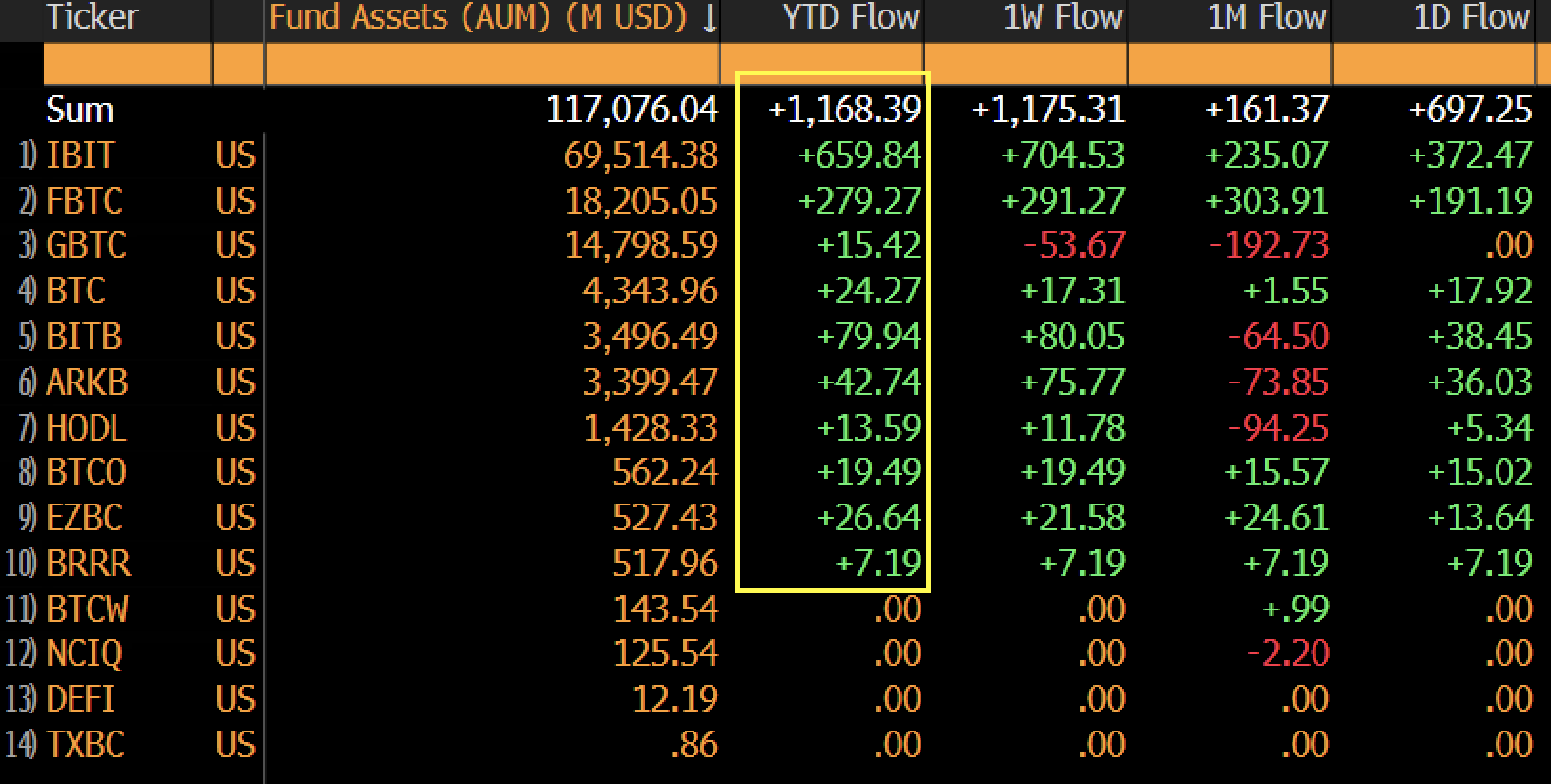
Spot Bitcoin ETFs attracted over $1.2B in inflows in the first two days of 2026 alone, implying an annualised pace north of $150B if sustained. This follows a year where Bitcoin ETFs ranked among the top inflow products globally, despite being one of the only major ETFs in the top cohort posting a negative annual return. That contrast shows demand driven by long-term allocation rather than performance chasing and it naturally raises the question of how flows might behave in a year where Bitcoin trends higher. BlackRock also recorded its largest single inflow in three months, while Ethereum ETFs saw roughly $340M in inflows over the same two-day period. Taken together, the early-year flow profile suggests institutional participation is accelerating into 2026, largely independent of short-term price direction.
Ethereum Staking Demand and Network Activity Strengthen
Ethereum’s staking dynamics have shifted meaningfully over the past two weeks. For the first time in nearly six months, the staking entry queue is larger than the exit queue, signalling that more ETH is waiting to be locked than unlocked. Roughly 1.32M ETH is currently queued to enter staking with an average wait time of around 23 days, while only about 3K ETH is waiting to exit, with a delay of roughly an hour. In simple terms, ETH is being committed to the network at a much faster pace than it is being withdrawn. Historically, rising entry queues tend to align with improving long-term conviction, while spikes in exit queues typically appear during periods of stress.
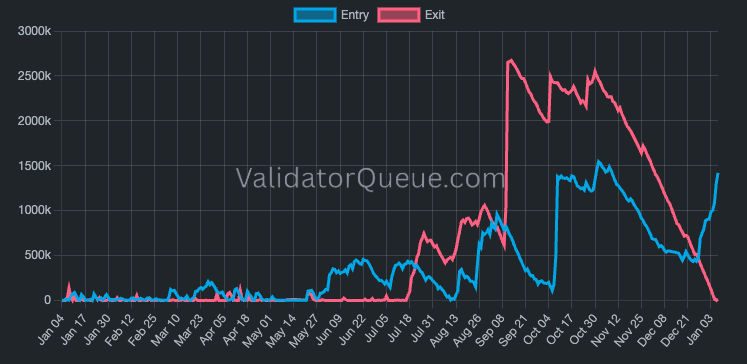
One structural driver behind this shift is the Pectra upgrade, which made staking more efficient for larger holders. By raising the maximum effective balance per validator from 32 ETH to 2,048 ETH, the upgrade significantly reduced operational complexity, allowing institutions and large stakers to consolidate rather than manage hundreds of smaller validators. This change lowers overhead, improves staking efficiency, and makes long-term participation in the network more attractive than keeping ETH liquid.
At the same time, network usage remains near cycle highs. Ethereum recently set a new daily transaction record with 2.2M transactions, reflecting sustained on-chain activity. Higher usage increases fee generation and ETH burn, tightening effective supply alongside rising staking participation. This combination, increasing lock-up and ongoing burn, reduces circulating supply during periods of elevated network demand.

Upcoming Token Unlocks Q1
January 2026 brings a notable amount of token unlocks across several large-cap and high-profile altcoins, making supply dynamics an important factor to monitor early in the year. Token vesting is designed to reduce sudden supply shocks by releasing allocations gradually over time, typically balancing long-term incentive alignment with controlled increases in circulating supply. Even so, larger unlock events can influence short-term market behaviour, particularly when liquidity is still rebuilding after the holiday period.
Among the more significant unlocks, ONDO leads the January calendar with approximately 1.9B tokens scheduled to unlock on January 19, valued at over $840M at current prices. This event will increase ONDO’s circulating supply by roughly 50%, with allocations spread across founders, team members, community incentives, and private investors. Bitget Token (BGB) follows with a 140M token unlock on January 26, worth close to $500M, with the majority allocated to team members and branding initiatives.
Hyperliquid saw a smaller but still material unlock earlier in the month, with 1.2M HYPE tokens distributed to core contributors on January 6, valued at roughly $312M. Despite the increase in circulating supply, HYPE has continued to trade in the $26–28 range, suggesting near-term demand has absorbed the release, with over 60% of total supply still locked. Meanwhile, $TRUMP is scheduled to unlock 50M tokens on January 18, worth approximately $270M, allocated to founders and team members. Taken together, January’s unlock schedule highlights the importance of monitoring supply expansion alongside improving sentiment, particularly as markets assess which projects can absorb new issuance without disrupting structure.


Kane Bisogni


.jpg)
Bitcoin Vs XRP: What Separates Them (And Why Investors Care)

Weekly Market Update: 18 March 2026
Weekly Market Update: 11 March 2026
Weekly Market Update: 04 March 2026
Weekly Market Update: 25 February 2026
.jpg)
Crypto vs Stock Trading: Which Is The right Investment For You in 2026
.jpg)
How to Buy XRP in Australia: A Complete Guide for Beginners in 2026
Weekly Market Update: 18 February 2026
Weekly Market Update: 11 February 2026
Weekly Market Update: 04 February 2026
Weekly Market Update: 28 January 2026

What Does Liquidity Mean in Crypto? A Beginner’s Guide
%20(1).jpg)
How to Build a Diversified Crypto Portfolio
Weekly Market Update: 21 January 2026
Weekly Market Update: 14 January 2026

The Best Crypto Brokers and Trading Platforms for 2026
Weekly Market Update: 07 January 2026
Weekly Market Update: 24 December 2025
Weekly Market Update: 17 December 2025
Weekly Market Update: 10 December 2025
Weekly Market Update: 3 December 2025
Weekly Market Update: 26 November 2025
Weekly Market Update: 19 November 2025
Weekly Market Update: 12 November 2025
.jpg)
SMSF Crypto Investing Australia: A Complete Guide
Weekly Report 5th Nov

DeFi Explained: How Decentralised Finance Is Changing Traditional Banking (Australia, 2025 Edition)
.jpg)
Our Guide to Meme Coins in 2026: How to Pick a Winner
.jpg)
Smart Contract Hacks Australia: How Exploits Happen and How to Protect Your Crypto
.jpg)
Institutional Money in Crypto: How Big Investors Are Changing the Game
.jpg)
Crypto Outlook 2025: Has the Bull Market Been Interrupted or Just Reset?
.jpg)
How Crypto Is Changing the Way We Buy Luxury
.jpg)
Real-World Assets (RWA): The Dominant Crypto Sector of 2025
.jpg)
Crypto Market Manipulation: How Liquidity Squeezes Shape the Market
Weekly Market Update: 22 October 2025
Weekly Market Update: 8 October 2025
Weekly Market Update: 15 October 2025
.jpg)
Crypto Scams Australia: A Beginner’s Guide to Safe Investing
Weekly Market Update: 1 October 2025
Weekly Market Update: 24 September 2025
Weekly Market Update: 17 September 2025
Weekly Market Update: 10 September 2025

Buying Cryptocurrency as a Company: Everything You Need to Know

How to Buy and Sell Large Amounts of Cryptocurrency (Including Bitcoin, XRP, ETH) in 2026
Weekly Market Update: 3 September 2025
Weekly Market Update: 27 August 2025
Weekly Market Update: 20 August 2025
Weekly Market Update: 13 August 2025
Weekly Market Update: 6 August 2025
Weekly Market Update: 30 July 2025
Weekly Market Update: 23 July 2025
Weekly Market Update: 16 July 2025
Weekly Market Update: 9 July 2025
Weekly Market Update: 2 July 2025
Weekly Market Update: 25 June 2025
Weekly Market Update: 18 June 2025
Weekly Market Update: 11 June 2025
Weekly Market Update: 4 June 2025
Weekly Market Update: 28 May 2025
Weekly Market Update: 21 May 2025
Weekly Market Update: 14 May 2025
Weekly Market Update: 7 May 2025
Weekly Market Update: 27 March 2024
Weekly Market Update: 3 April 2024
Weekly Market Update: 10 April 2024
Weekly Market Update: 17 April 2024
Weekly Market Update: 24 April 2024
Weekly Market Update: 1 May 2024
Weekly Market Update: 8 May 2024
Weekly Market Update: 15 May 2024
Weekly Market Update: 22 May 2024
Weekly Market Update: 29 May 2024
Weekly Market Update: 6 June 2024
Weekly Market Update: 12 June 2024
Weekly Market Update: 19 June 2024
Weekly Market Update: 26 June 2024
Weekly Market Update: 4 July 2024
Weekly Market Update: 10 July 2024
Weekly Market Update: 17 July 2024
Weekly Market Update: 24 July 2024
Weekly Market Update: 31 July 2024
Weekly Market Update: 8 August 2024
Weekly Market Update: 14 August 2024
Weekly Market Update: 21 August 2024
Weekly Market Update: 28 August 2024
Weekly Market Update: 4 September 2024
Weekly Market Update: 11 September 2024
Weekly Market Update: 18 September 2024
Weekly Market Update: 25 September 2024
Weekly Market Update: 2 October 2024
Weekly Market Update: 9 October 2024
Weekly Market Update: 16 October 2024
Weekly Market Update: 23 October 2024
Weekly Market Update: 30 October 2024
Weekly Market Update: 6 November 2024
Weekly Market Update: 13 November 2024
Weekly Market Update: 20 November 2024
Weekly Market Update: 27 November 2024
Weekly Market Update: 4 December 2024